| Here are a few reasons we think racing "over there" is something you should see:
1. Every course is different.
In America, tracks are oval-shaped, flat, dirt or artificial-surfaced, and about a mile around. If there's a grass course, it's smaller, tighter, and tucked inside the main track. Exceptions like Belmont's mile-and-a-half, Woodbine's "outside" turf course, Kentucky Downs' pear-shape, and Santa Anita's hillside only prove the rule. Horses make a quarter-turn to the right coming down the hill at Santa Anita, and a bit of a bend to the right at Kentucky Downs, but barring that, all American racing is left-turning/counter-clockwise.
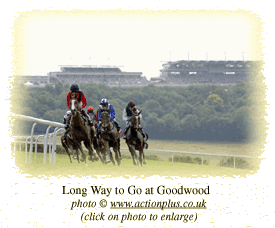 In Europe, sometimes they turn left, sometimes they turn right, and sometimes they do both in the same race. Flat racing, the term used to distinguish it from jump racing, is "flat" in name only. Most courses have surfaces that undulate with varying degrees of severity. In Europe, sometimes they turn left, sometimes they turn right, and sometimes they do both in the same race. Flat racing, the term used to distinguish it from jump racing, is "flat" in name only. Most courses have surfaces that undulate with varying degrees of severity.
And they come in all sizes and shapes. Ascot is triangular and about 1 3/4 miles around. Longchamp is horseshoe-shaped and even larger. Windsor is a figure-8. Newmarket is sort of boomerang-shaped, over two miles long, and splits into two separate finishing straights used at different times of the year. Goodwood's layout defies easy description; it's kind of L-shaped, but has loops in it to accommodate longer distances, and in some races the horses cross the same part of the track going different directions at different times. Epsom is the quintessentially eccentric run, with right- and left-hand bends, a climb of nearly 150 feet within three-quarters of a mile, and a steep and famously tricky downhill turn.
Even courses like Chantilly, York, Newbury, and The Curragh, all considered to be open and galloping in nature, have a surprising unevenness when you walk them, and each has its own distinctive configuration. Deauville, in the exception that proves this rule, is perfectly flat and oval-shaped.
This course diversity adds a flavor missing in America. And not only from the viewing angle. Different types of horses do well or poorly on different kinds of tracks. A nimble, handy horse will move up on a tight-turned course with a lot of elevation changes. Powerful, long-striding ones will be favored by flatter, broader-bending tracks. "Horses-for-Courses" has a deeper meaning in Europe, and it's a compelling if occasionally frustrating aspect to handicapping there. Every race is a specific situation.
A final thing: racing in Europe is conducted almost exclusively on grass. Dirt or artificial surfaces are still rare. You have to see the difference to appreciate it.
2. Another Kind of Season.
U.S. race meetings are long, typically two to four months, and racing is held five or six days a week. The circuits are widely separated geographically, and tend to be relatively "closed". There's not a lot of back-and-forth between New York and California — or, for that matter, New York and Maryland. And racing starts on January 1 and "ends" on December 31.
In Europe, race meetings are short. One-day meetings are the most common, and even the highly prestigious, like Royal Ascot or Glorious Goodwood, take place over five days at most. This makes each racing day special, more of an event. Local fans flock to their home tracks for even ordinary cards - and on the big days, serious followers of the sport come in from all over the British Isles and the Continent.
At the most important meetings, high-class racing is concentrated. Royal Ascot is the extreme example: eighteen Group races ("Group" races are the equivalent of our "Graded" races) are held over the five days, but the other major meetings are loaded also: York's August meeting has eight Group races in three days, and Glorious Goodwood has thirteen in five - eight in the first three days alone. Longchamp is known for its cards containing four or five Group races scattered throughout the year, and on Arc Weekend in October France-Galop puts on eleven group events in two days.
The big meetings bring out the good horses, from all over. More so than in the U.S., horses tend to show up for the races for which they should show up, because they don't often have as many other options. And the undercards at the premier meetings are usually very strong, sprinkled with "Listed" races (more or less the same as an ungraded stake race in the U.S.), and maiden races packed with expensive, well-bred newcomers.
The European racing calendar is limited. Major flat racing starts in late March in England and Ireland, a bit earlier in France, and is over by the middle of November. The four months off, comparable to our off-season in baseball or football, means that everybody is "ready" when the racing starts again. Coming over from America for a couple of weeks, you won't have lived through the quiet time, but you'll get the benefit of its effect: The fans got de-jaded, the horses got freshened, and the owners, trainers, and jockeys got hungry to start running and winning again. It's an extra boost to the buzz level that lasts all year long.
3. There's More Variety.
Tired of six-furlong dirt races with the occasional dirt or grass "route" of a mile and a sixteenth thrown in, and a stake at a mile and an eighth? Europe offers tonic.
European flat races range from five furlongs to well over two miles. It's not unheard of to have a seven-race card with seven different distances. Among other things, this means more horses develop status and followings because there are more ways for them to do it.
So-called "middle-distance" runners battle it out over ten to twelve furlongs, the length of most of the very richest and most important events, but milers are an honored caste also, and have their own menu of traditional and rich events throughout the year. Sprinters knock heads at five or six furlongs, usually on straight courses that minimize luck. And "Cup" horses have their place too, in a way long gone in America. Two-mile races aren't at all uncommon, and England and France each have Group 1's at two-and-a-half miles. The traditional closing race at Royal Ascot is over 2 3/4 miles. Persian Punch, probably the most popular English runner of the last decade, made his reputation almost exclusively in races of more than two miles, winning several Group events in 2003 at the age of ten.
4. The Crowds.
They're bigger, they dress better, and they know more.
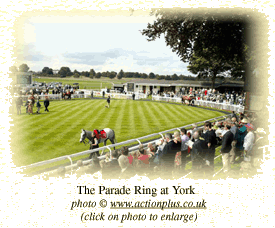 As noted above, European racegoers look forward to their days at the course. It's an occasion, and they come to have a good time. Lunch is often a part of the experience, and the bars are well-attended. Few people pass up the opportunity to have a financial opinion on every race, and they are demonstrative in supporting their choice. The crowd sound that greets a field digging up the long inclined stretch at Sandown will give you goosebumps the first time you hear it. As noted above, European racegoers look forward to their days at the course. It's an occasion, and they come to have a good time. Lunch is often a part of the experience, and the bars are well-attended. Few people pass up the opportunity to have a financial opinion on every race, and they are demonstrative in supporting their choice. The crowd sound that greets a field digging up the long inclined stretch at Sandown will give you goosebumps the first time you hear it.
Rules of attire are more rigorous than in the U.S., and in the "Members Enclosure" - analogous to the American "Clubhouse" - the men are in jackets and ties and the ladies are well turned out. Each meeting, depending on its caliber, location, and time of year, has its own style. The Royal Enclosure at Ascot is strictly formal, and the other big Ascot meetings tend to be dressy as well. Glorious Goodwood in July is chic and summery. Tweeds are more in evidence in the spring and fall. Deauville is relaxed but beach-resort smart, and Longchamp is big-city fashionable. At the little meetings, everybody knocks it down a notch or two but few people look ragged.
And they know their stuff. Every crowd will have its share of first-timers and youngsters there just for the party, but to an extent you don't see here, Europeans follow the sport. In England, a horse named Royal Chip, just to make up an example, will actually be referred to as "Royal Chip" as he parades in the paddock. Maybe even "R.C." or "Chippers" if he's been around a while. Seldom would he be called "the 7-horse".
And R.C.'s proclivities — whether he likes it firm or soft, does better earlier in the year or later, and whether he's "progressive" or "over-the-top" - would be known to many in the crowd without the need for consulting their racing paper.
5. Bookmakers.
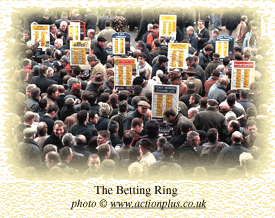 For an American, one of the pleasures of going racing in England and Ireland is betting with the bookmakers. At each course, down on what we'd call the apron of the track, there's an area called the Betting Ring. In it, independent bookies are arrayed in lines, each with their own boards, each offering their own odds on every race. For an American, one of the pleasures of going racing in England and Ireland is betting with the bookmakers. At each course, down on what we'd call the apron of the track, there's an area called the Betting Ring. In it, independent bookies are arrayed in lines, each with their own boards, each offering their own odds on every race.
It's fun to work your way through the ring and shop for a price on your pick. It's a multi-sense atmosphere, calm but electric. And it's amazing the satisfaction you get from picking up a half-point on your "fancy" by going up and down the line a couple of times. The best thing is: you're paid the odds posted at the time you made your bet. No getting killed by whale-induced last-flash price drops.
Pari-mutuel wagering is the only legally-allowed way to bet in France, where, incidentally, our modern American system originated. It's also available in England and Ireland, where it's called the "tote".
Often it can be smarter to bet through the tote than with a book, and there are many opinions about when it's best to use the one and when it's best to use the other. Deciding that is part of the fun.
Complaints are leveled against the bookmakers in that they could do more to financially support the sport. The bookmaking community is an entrenched and powerful political lobbying force, and one that resists calls for increased contributions that would upgrade purse money for owners. Knowing this tempers our enthusiasm for using them a bit, but we still recommend making them a part of your experience.
6. Tradition.
The oldest English horse races are the longest-running sporting events in the world. The St Leger at Doncaster was first held in 1776, and excepting a few substituted locations during the World Wars, has been run over the same patch of real estate every year since 1778. The Derby and Oaks date from the same period and many other English races have pedigrees in the two-hundred-year range. We barely had a country then.
The roots of English racing, and therefore racing as it is conducted all over the world today, go back even further. Ascot's first races were held in 1711, and Newmarket's first recorded ones in 1622, just two years after the voyage of the Mayflower. The "Knavesmire" in York has seen racing for hundreds of years. On the "Roodee", site of the present-day course in Chester, horse races were held by the Romans.
Think about whose footsteps you might be walking in when you're on your way over to the paddock to check out the first-timers in the four o'clock maiden race.
7. The Horses are Different and They Could be Better.
Let's start with the "different" part: in Europe, racehorses are kept and trained in a manner quite unlike they are in America.
 Here, horses usually are stabled right at the racetracks, the bulk of which are in the center or suburbs of big cities. They spend most of their time in their stalls and get out for an hour or so in the morning. They are groomed by one person and ridden for their exercise by another. They gallop a time or two around the one-mile track, and have the occasional speed drill over three to six furlongs, in an atmosphere that has more than a passing resemblance to an outdoor bumper-car track, albeit one with amazingly few actual collisions. Here, horses usually are stabled right at the racetracks, the bulk of which are in the center or suburbs of big cities. They spend most of their time in their stalls and get out for an hour or so in the morning. They are groomed by one person and ridden for their exercise by another. They gallop a time or two around the one-mile track, and have the occasional speed drill over three to six furlongs, in an atmosphere that has more than a passing resemblance to an outdoor bumper-car track, albeit one with amazingly few actual collisions.
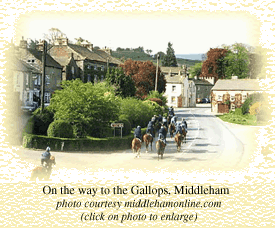
In Europe, horses are kept at training centers out in the countryside. They are usually ridden by the same person who rubs them. They are normally out of their stalls for several hours each morning, walking to and from the vast open areas in which they exercise. They cross roads, go through woods, and occasionally walk right through the middle of towns. They have long, stiff gallops, often uphill and often repeated, and fewer works for sheer speed. Because of the endless variety of European racecourses, they have to be taught to cope with a lot more things.
European horses appear, to this admittedly non-professional eye, to be healthier and saner than their American counterparts. They look to carry more condition, and to be better "citizens". They go out to the start of their races unaccompanied by ponies. The near-universally-used American medications of butazolidin and lasix are not permitted on race days.
Are European horses better right now?
It's hard to say for sure, but quite possibly. It's an endlessly debatable question, and opinions are vehemently argued and defended on both sides of the Atlantic. And if they are better, it's likely due to the way they're handled rather than the raw material itself - the internationalization of the Thoroughbred bloodstock industry means that young American-bred horses in large numbers are annually bought in the U.S. to race in Europe. It happens the other way, too.
Horses here vs. horses there? We have our impressions but feel obligated to repeat they are not those of a professional.
We think you ought to come over with us and see the Euros work and race on their home ground. Then you can make up your own mind. And we think you'll come back with a new appreciation for the sport we all love.
Racing photos © www.actionplus.co.uk
Our Philosophy | Why Racing in Europe | Our Itineraries |
2024 Trips | 2023 Trips
Previous Years | Custom Trips | Who We Are | Testimonials | Contact Us | Home

Copyright © 2004-2024
Racing-Europe LLC
All Rights Reserved. |
|